
The productivity of grassland ecosystems on the Qinghai–Tibet Plateau (QTP) not only underpins the sustainability of regional pastoralism but also regulates water cycling and ecological security in the “Asian Water Tower.” Although widespread greening has been observed under climate change, it remains debated whether greening enhances drought resistance or, conversely, heightens ecosystem sensitivity to water stress.
To address this question, the team led by Prof. ZHAO Wei at the Institute of Mountain Hazards and Environment, Chinese Academy of Sciences (IMHE, CAS), used long-term satellite observations to develop three drought-impact metrics—loss probability, loss intensity, and drought tolerance threshold—and then quantified how trends in the normalized difference vegetation index (NDVI) relate to drought sensitivity and net primary productivity (NPP). Approximately 75% of QTP grasslands exhibited significant greening, concentrated in the mid-to-late growing season and at lower elevations. Despite an increase in tolerance thresholds within these greening areas, drought-related losses became more frequent and more severe, revealing a characteristic “high-exposure, high-response” pattern—especially during the mid-growing season and at 3,000–3,500 m elevation. Drought impacts showed an elevation-dependent transition, with ecosystem stability declining markedly between 3,500 and 4,500 m. Greening and drought impacts were nonlinearly related: drought losses initially increased at low greening rates but declined after an inflection around 0.12–0.15 × 10⁻² yr⁻¹, indicating that the reinforcing versus mitigating effect of greening depends on its magnitude. Soil-moisture constraints were strongly seasonal—suppressing NPP early in the growing season but enhancing it later. Together, these findings reveal threshold-type nonlinearity and pronounced elevational differentiation in the greening–drought coupling, provide a scientific basis for water-management and risk-zoning of QTP grasslands, and caution against the misconception that “greening equals safety.”
The study, entitled “Greening Nonlinearly Intensifies Drought Impacts on Grasslands of the Qinghai–Tibet Plateau,” is published in Global Change Biology. Funding was provided by the National Natural Science Foundation of China, the CAS Key International Cooperation Project, the IMHE intramural program, and the Tibet Autonomous Region Science and Technology Program.
DOI: 10.1111/gcb.70532
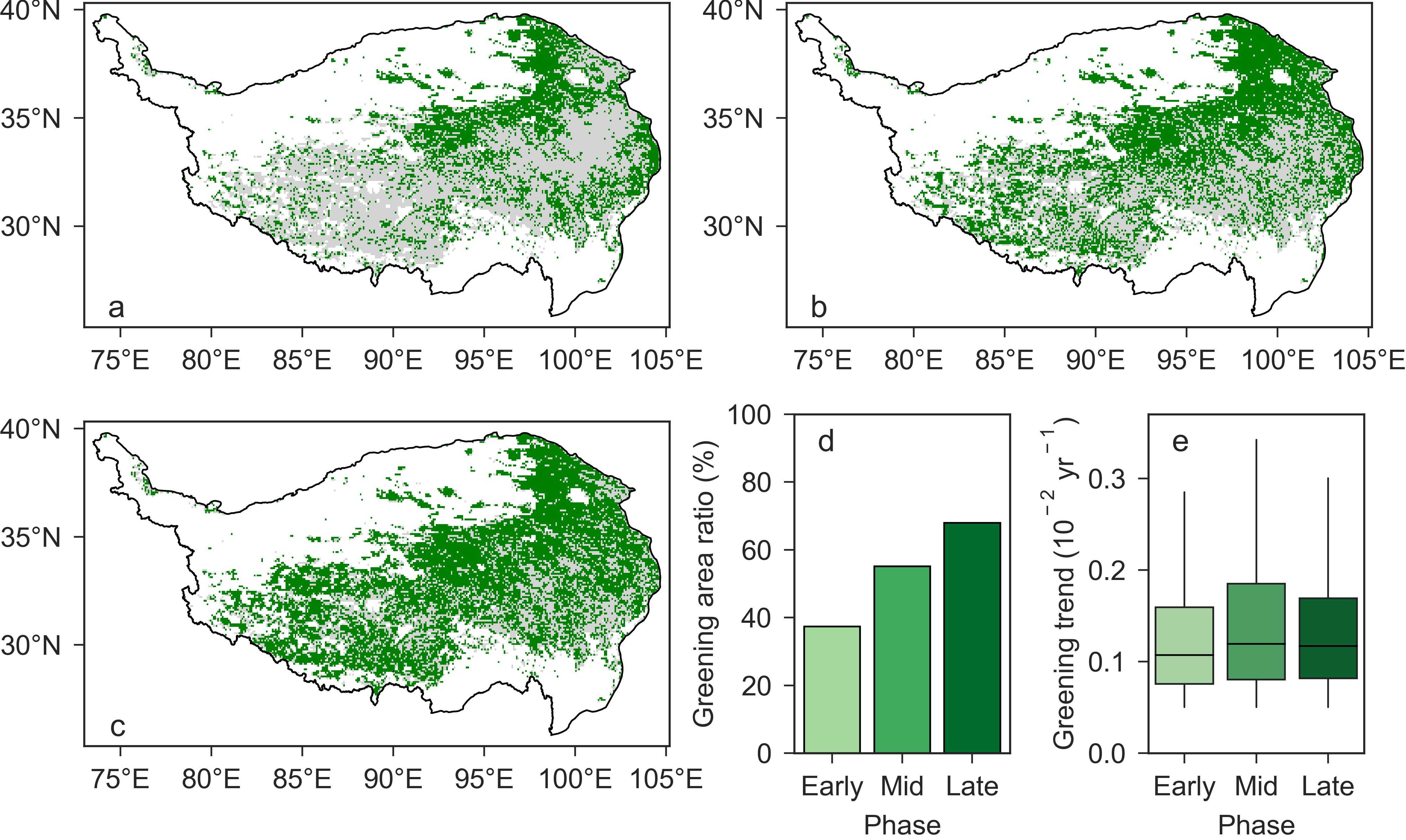
Areas of greening during the early (a), mid- (b), and late (c) growing-season stages, and the fraction of greening (d) and the slope of greening trends (e) (Image by ZHAO Wei)
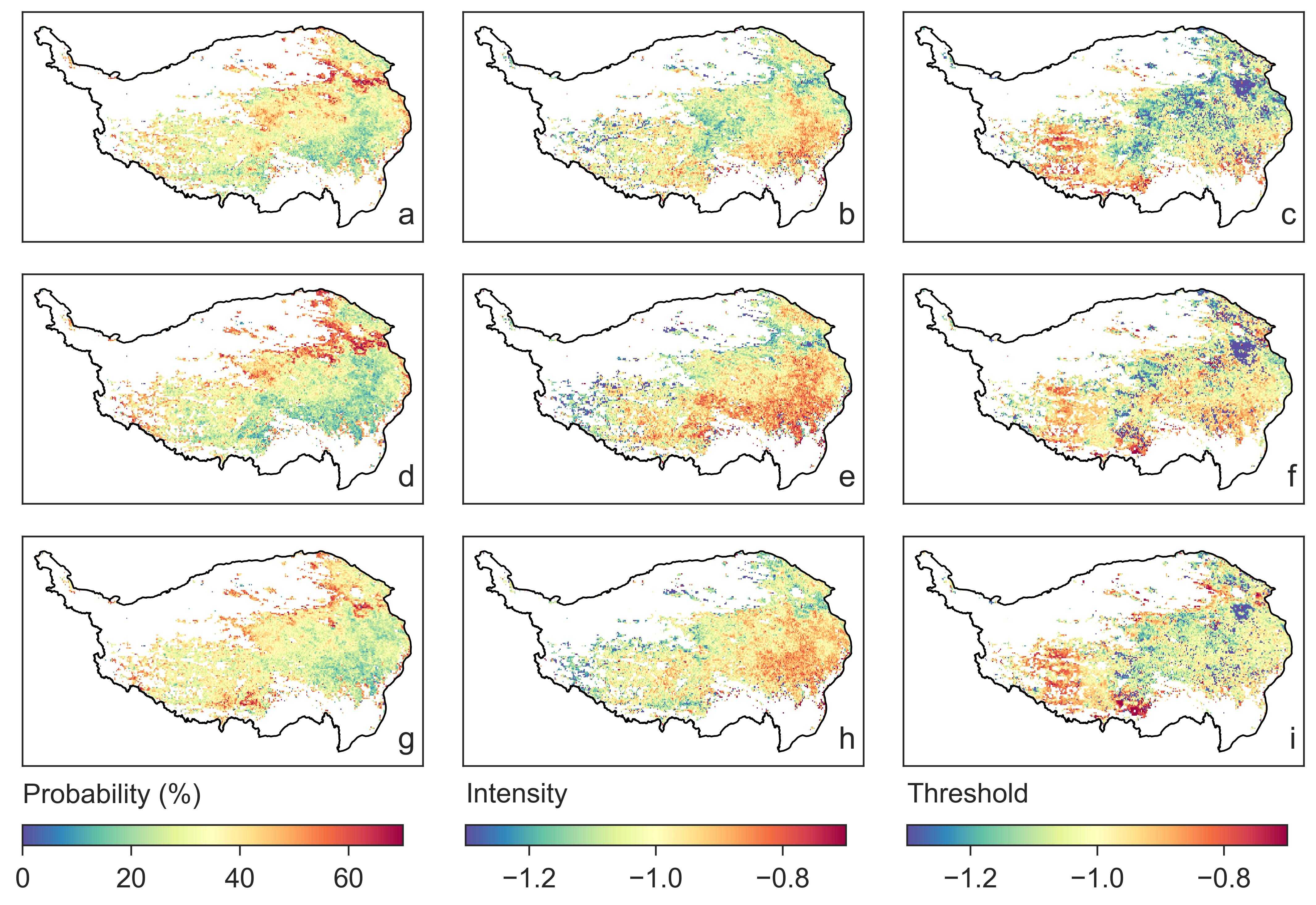
Spatial patterns drought impacts on net primary productivity (NPP) during the early (a–c), mid- (d–f), and late (g–i) growing-season stages across the Qinghai–Tibet Plateau grasslands (Image by ZHAO Wei)
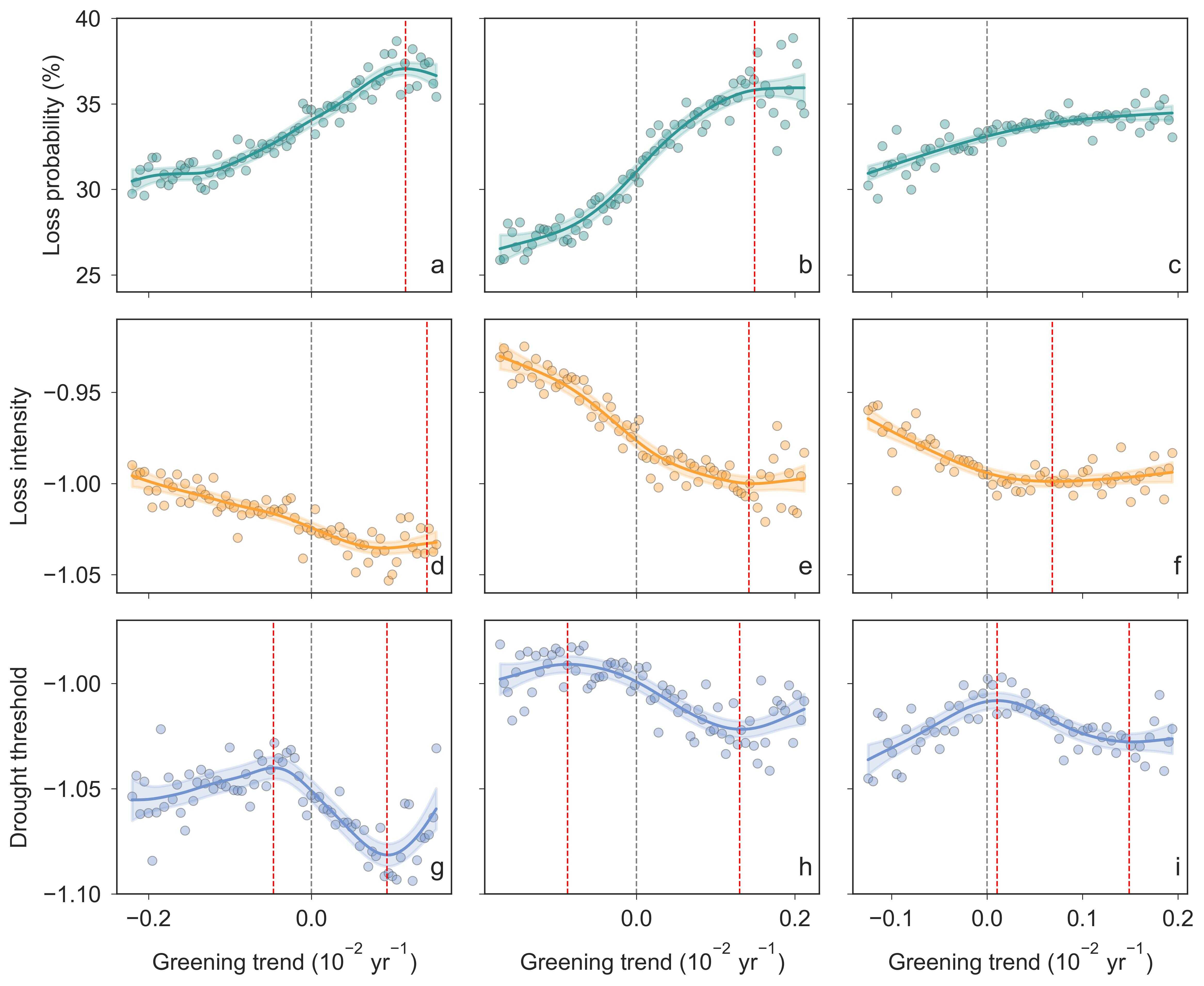
Relationships between greening trend and (a–c) drought loss probability, (d–f) mean loss intensity, and (g–i) the drought threshold for the early (a, d, g), mid- (b, e, h), and late (c, f, i) growing-season stages (Image by ZHAO Wei)