
Climate change is reshaping the vegetation growth environment by altering regional and global hydrological cycles and surface thermal regimes. These changes are expressed as an uneven seasonal distribution of precipitation and rising temperatures, resulting in temporal mismatches between the water and heat demands of vegetation and the climate supply.But the patterns and mechanisms of these changes remain unclear.
To address this scientific question, the Artificial Intelligence and Mountain Eco-environment Innovation Team of the Institute of Mountain Hazards and Environment, Chinese Academy of Sciences, in collaboration with researchers from the University of Hong Kong and Xinjiang University, conducted a synergistic analysis of multisource and multitemporal remote sensing data. A vegetation–climate response time model integrating both lag and cumulative effects was developed to investigate the reshaping process of the dominant climate factors of China's vegetation from 1982 to 2022. Results showed that the response intensity of more than 90% of vegetation to the climate was underestimated without considering the vegetation response time, while the rest was overestimated. China's vegetation response was primarily temperature-driven. Vegetation dominated by temperature accounted for 81.55%, whereas vegetation dominated by precipitation accounted for 18.45%. However, under climate warming, 52.71% of vegetation shifted from temperature- to precipitation-driven regimes. Vegetation responses to precipitation accelerated and intensified over time, particularly in cold, dry, and high-altitude regions. This transition suggests a potential early signal of increased precipitation control on global vegetation, with important implications for predicting ecological dynamics and developing climate adaptation strategies.
The related findings were published in GIScience & Remote Sensing. The study was supported by projects including the Third Xinjiang Scientific Expedition. Meihong Wang, a jointly trained master’s student, is the first author, and Associate Researcher Hui Zhao is the corresponding author.
Link:https://doi.org/10.1080/15481603.2026.2651958
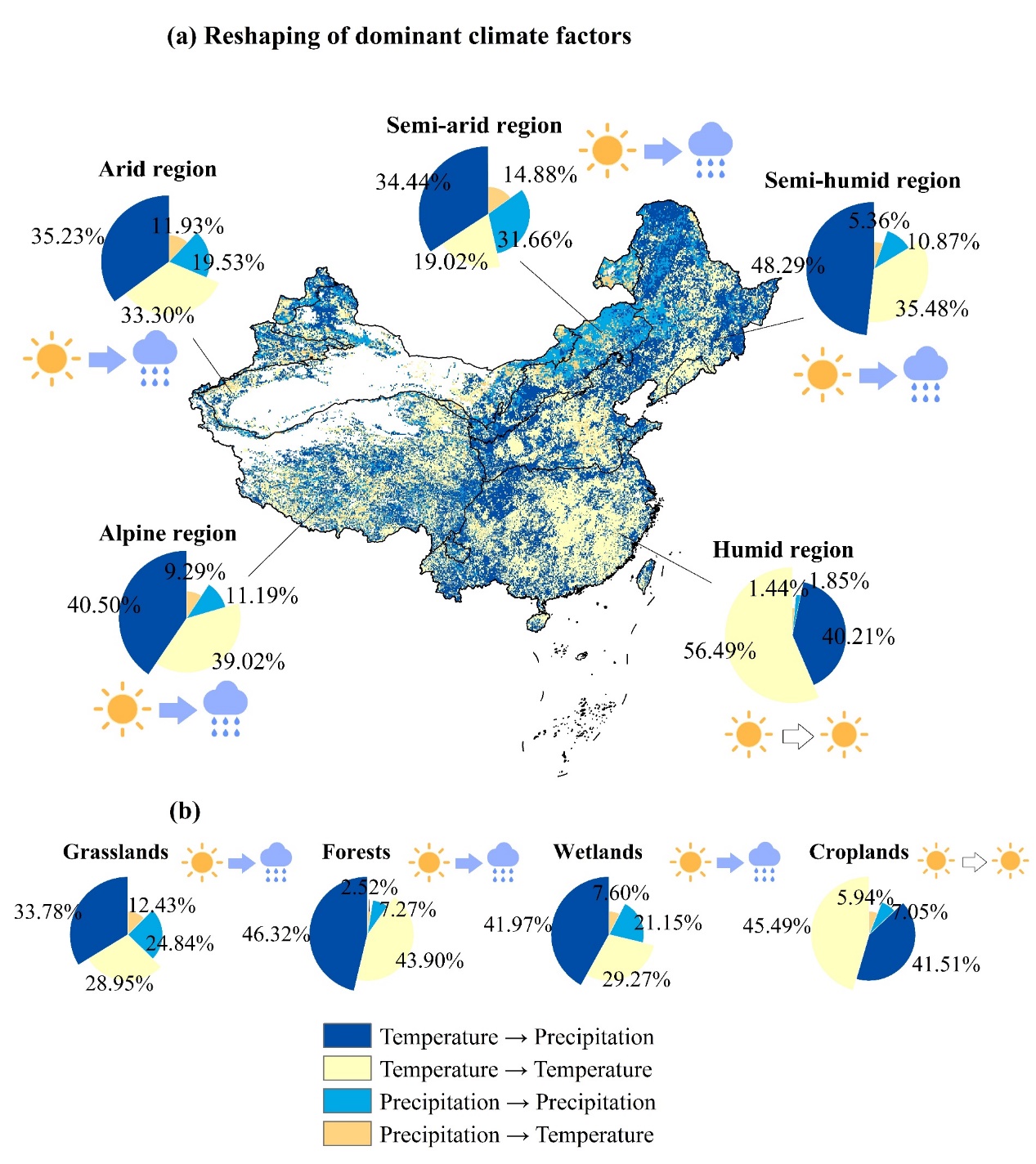
Figure 1. Reshaping process of the dominant climate factors affecting the NDVI across (a) different regions and (b) vegetation types. The pie charts in figures (a) and (b) show the proportions of different dominant climate shifts for different regions and vegetation types. (Image by ZHAO Hui's team)