
Soil infiltration is a core process in hydrological cycling, agricultural irrigation, and the prevention and mitigation of mountain geohazards. Physically based infiltration models (e.g., the Richards equation and the Green-Ampt model) have clear physical foundations, but they involve strong nonlinearity, complex solution procedures, difficult parameter acquisition, and stringent requirements for initial and boundary conditions. Empirical models (e.g., the exponential Horton model and the power-law Modified Kostiakov model) are easy to compute, but their applicability depends strongly on soil type and observation duration, and they lack a unified criterion for model selection. Existing fractional-order infiltration models (e.g., the TSD model) introduce memory effects, yet their use remains limited; they can produce physically unreasonable negative infiltration rates and are insufficiently stable and general.
To address these issues, a research team led by Xiaojun Guo at the Chengdu Institute of Mountain Hazards and Environment, Chinese Academy of Sciences, introduced the Caputo fractional derivative and the Mittag-Leffler function to develop a unified fractional-order infiltration (ML) model, expressed as f(t) = fc + bEα(-λtα). With the core parameter α (0 < α ≤ 1), the model enables a smooth transition between exponential and power-law decay: when α = 1, it reduces to the classical Horton exponential model; when 0 < α < 1, it describes a transitional infiltration form from exponential decay to power-law decay. Model parameters were optimized using a hybrid algorithm combining particle swarm optimization with Latin hypercube sampling.
Validation with 605 datasets selected from the global soil infiltration database (SWIG) showed that the ML fractional-order infiltration model achieved NSE > 0.95 in 84.46% of cases and relative errors below 20% for 80.8% of data points. The model covered nine typical soil texture classes, and all soil classes reached good or better fitting performance (NSE ≥ 0.75). Compared with four models (Horton, Modified Kostiakov, Philip, and TSD), the ML model had the lowest RMSE (0.73) and MAE (0.54), thereby improving infiltration-fitting accuracy while substantially reducing uncertainty in model selection.
The findings were published in 2026 in the Journal of Hydrology (Vol. 674, Article 135443), a leading international journal in hydrology. This research was funded by the National Natural Science Foundation of China (No. 42322703), and Xinyi Guo is the first author of the paper. Paper link: https://doi.org/10.1016/j.jhydrol.2026.135443
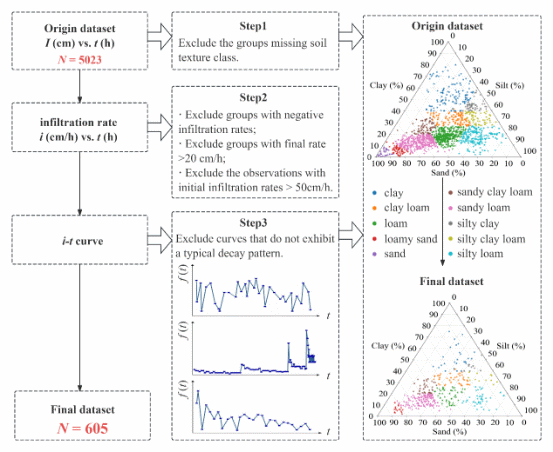
Supplementary Figure 1: Flowchart for screening the model-validation data.(Image by GUO Xiaojun' team)
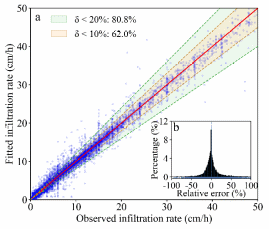
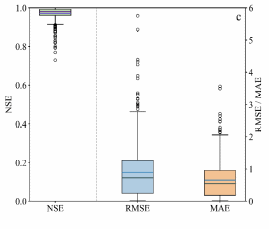
Supplementary Figure 2: Fitting performance of the ML infiltration model for the 605 datasets.(Image by GUO Xiaojun' team)